We'd mentioned that we wanted to go up to Glaciar Albino to a few people in Ushuaia in the hope of getting some information about the walk. The tourist office had sent us to the office of Club Andino, where the bored woman at the counter suggested a tourist agency to organise a guided tour, before returning as quickly as possible to updating her facebook profile.
At Antarctica Hostel, where the bubbly staff had provided us with lots of tourist information, I'd had the same conversation about five times.
Me: We'd like to walk up to Glaciar Albino and wanted to know what the conditions were up there.
Staff: No, no. You mean Glaciar Martial.
Me: No, I mean Glaciar Albino.
Staff: No, it's called Glaciar Martial.
Me: I know that, but I don't want to go to that one. I want to go to Glaciar Albino!
Glaciar Martial is the ice bucket sized glacier above town, which provides beautiful views of the Ushuaia and surrounds. But after walking up the Cerro del Media the previous day where we'd had a great view already we were after something a little different. And to be honest we really wanted to step off the beaten track and explore the wild side of this supposedly wild continent.
Unfortunately the complete lack of information was making this difficult. In fact, we'd had so much trouble already, that we'd bought Lonely Planet's 'Trekking in the Patagonian Andes' which was how we even knew about the walk. But instead of getting an impression of conditions, all we'd heard was that it was probably impossible and there was likely to be too much snow which only served to strengthen our resolve to clamber up there. As long as no one said the word 'avalanche' as they had in Bariloche, we figured everything would be sweet.
Our specially ordered bus was over half an hour late to collect us and in the meantime we'd picked up another recruit for the trek, right from our very own dorm room. Mark had ridden a motorbike from Peru to Ushuaia which immediately endeared him to us and Jeff had already spent hours discussing logistics and motorbikes. What's more he was the one going to Antarctica in just a few short days. Check out his blog 'A Motorcycle Diary'.
Despite attempting to persuade the driver to drop us off at the start of the trail where you don't need to pay, we arrived at Refugio Valle los Lobos where the woman at reception negotiated our time of pick up with the driver and gave us a mud map up to Lago Esmeralda. Mention of the glacier was met with a mumbled jumble of words that included 'snow', 'difficult' and 'impossible'. So we set off with no further instructions, no accurate map, knowing the trail was unmarked and with two hours less than we'd hoped. The driver had seemed unhappy with our initial agreed time of 7pm, so she'd negotiated our pick up for 5pm.
The lake was an easy walk of one hour through the bright green lenga forest. At the edge of the forest there was a large bog and despite instructions to follow the bank of the stream, we followed an alleged path straight through. On the other side, my socks were already damp after sinking into almost ankle deep mud and stepping on spongy mosses. Please don't even mention my guilty conscience.
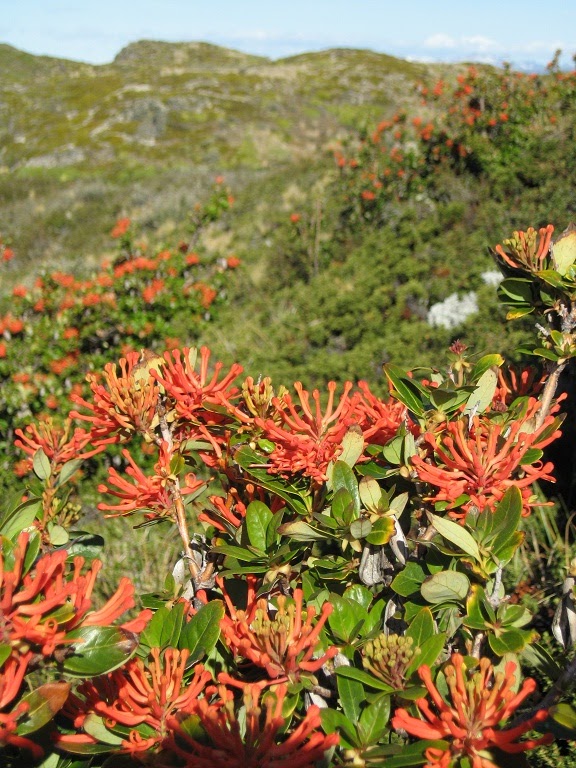
After another quick climb we were on the pebbly shore of the turquoise laguna surrounded by 1000m peaks. In the valley above the tree line where we were supposed to walk, pristine snow reflected brightly in the sunlight. On the other side of the laguna was a beaver dam next to a whole forest of fallen trees, that had been efficiently cut down by the little critters. They are a pest down here and looking at the destruction it was easy to see why.
On the other side of the forest, just before leaving the tree line we came across the first patch of snow which was easily crossed. But the second one, which looked about 1m deep seemed like it would stop us in our tracks. Luckily there was a way around and up into the valley.
We were following a rough track when it emerged out of the snow. As we got higher, we'd scramble up the slippery moraine, where there was more and more snow and less rock. In some patches the snow would reach up to our knees when a boot inadvertently fell through. On the cliffs around us, there were small waterfalls from all the melting snow above that together sounded much bigger.
The guidebook helpfully advised to turn left at the grey rock before clambering up a steep section. We assumed that the grey rock must have still been buried and continued up the snow before turning towards the only rocky outcrop where we could possibly walk. By now the slope was so steep that we were using our hands to clamber up the snow. Stopping every now and then to catch my breath and admire the foot holes in the pristine snow, I was relishing the descent.
At the top of the rocky outcrop there was no glacier. Instead there was another little waterfall with its water was running directly under the snow we were walking on, before cascading off the red and orange cliff edge.
Continuing along the plateau, we were convinced the glacier was just over the next section of rock around the corner. But all we found was another crest, with more jagged peaks in the distance. Little piles of rocks were dotted here and there, but they ended abruptly and the only other indication of a path was a set of footprints in the snow on a distant section of the slope. We wanted to keep going but we simply didn't have any more time and without knowing exactly where the glacier was we could have kept going on and on. So instead we had lunch, with a spectacular view of the lake way down below, surrounded by forest and mountains.
While the ascent had made us feel like adventurous mountaineers, on the descent it was like we were little kids again. As soon as the slope was big enough we jumped onto our waterproofs jackets and plastic bags and slid down the hill on our backsides. I had a distinct feeling that as a kid I'd been told not to do this probably so I didn't end up with wet clothes and boots and snow everywhere. From the bottom we admired our slide marks in the snow that could even been seen from the far shore of the lake.
We made it back for the taxi just on time and at the hostel looked at the topographic map of the area. It looked like the glacier was exactly where we'd thought. But despite the feeling that it was still unconquered it was a brilliant day and we definitely deserved the the calafate berry flavoured ice cream that evening.
Showing posts with label Cerro del Media. Show all posts
Friday, 10 December 2010
Glaciar Albino & Lago Esmeralda
Labels:
Argentina,
Cerro del Media,
Glaciar Albino,
Lago Esmeralda,
Snow,
Ushuaia
Thursday, 9 December 2010
Cerro del Media & the Beagle Channel
From the top of the mountain, Ushuaia looked beautiful. Built on the hillside we'd just climbed, it's gaze seemed permanently fixed on the Beagle Channel and those travelling at the end of the world.
With just a few hours to spare before our intended boat trip – weather permitting – we'd hiked for two hours through the damp lenga forest that we'd grown used to in Patagonia. Near the top we'd slipped our way crossing a bit of snow at the edge of the tree line before reaching the lookout.
Further along there was supposed to be a lagoon so we'd followed the stone markers across the bare, rocky ground. Again, a large patch of snow covered the trail that led up the hill to the lagoon, which turned out to be less of a lagoon and more of a puddle.
After leaving big boot prints in the pristine snow on the way up, Jeff decided to create another set of marks in the snow. He slid all the way down the hill on his backside, almost hitting a rock at the bottom when his steering failed.
That afternoon the wind hadn't picked up and the port of Ushuaia was open for business. We set sail with Patagonia Adventure Explorer on the slightly crowded boat, our stern pointing towards Alicia Island.
'Island' is probably too generous a name for the hunk of rock sticking out of the middle of the channel, but it was here that an entire colony of sea lions were basking in the sun. They were a lazy bunch with not even a flipper moving to show any sign of life. As our boat neared, a few heads moved to look at us and one sea lion sat up and posed for the cameras.
Leaving the colony to their sleep we continued sailing out to Les Eclaireurs Lighthouse the little red and white lighthouse that is the symbol of Ushuaia. With it's backdrop of snow capped mountains and blue water it looked very picturesque on that perfectly clear afternoon. In fact there were so few waves, I was a little disappointed!
On Isla de los Lobos another colony of sea lions lazed in the sun, while on the other side cormorants fed their newly hatched chicks, that we could hear and see squawking in their nests.
Isla de Pajaros, another rocky island was home to a different type of cormorant which our guide was at pains to point out were not penguins. Obviously the sheer quantity of what appeared to be black and white dinner jackets fooled a lot of people, including us. The cormorants were arriving here for the summer to nest, so the colony was multiplying daily.
The final stop was on one of the Bridges islands, where we wandered windswept paths in the place where the indigenous Yamana people had once lived. Covered in low shrubs and mosses, some of which grew just a millimetre a year, the island was in the full bloom of spring.
We took particular note of the Calafate bushes, whose berry, once eaten insures a return to Patagonia. For the moment, there were only pretty yellow flowers, but there were many options to try them in a preserved form. Our guide recommend the Calafate berry flavoured ice cream, a suggestion we took very seriously...to ensure we made it back to this beautiful part of the world of course!
With just a few hours to spare before our intended boat trip – weather permitting – we'd hiked for two hours through the damp lenga forest that we'd grown used to in Patagonia. Near the top we'd slipped our way crossing a bit of snow at the edge of the tree line before reaching the lookout.
Further along there was supposed to be a lagoon so we'd followed the stone markers across the bare, rocky ground. Again, a large patch of snow covered the trail that led up the hill to the lagoon, which turned out to be less of a lagoon and more of a puddle.
After leaving big boot prints in the pristine snow on the way up, Jeff decided to create another set of marks in the snow. He slid all the way down the hill on his backside, almost hitting a rock at the bottom when his steering failed.
That afternoon the wind hadn't picked up and the port of Ushuaia was open for business. We set sail with Patagonia Adventure Explorer on the slightly crowded boat, our stern pointing towards Alicia Island.
'Island' is probably too generous a name for the hunk of rock sticking out of the middle of the channel, but it was here that an entire colony of sea lions were basking in the sun. They were a lazy bunch with not even a flipper moving to show any sign of life. As our boat neared, a few heads moved to look at us and one sea lion sat up and posed for the cameras.
Leaving the colony to their sleep we continued sailing out to Les Eclaireurs Lighthouse the little red and white lighthouse that is the symbol of Ushuaia. With it's backdrop of snow capped mountains and blue water it looked very picturesque on that perfectly clear afternoon. In fact there were so few waves, I was a little disappointed!
On Isla de los Lobos another colony of sea lions lazed in the sun, while on the other side cormorants fed their newly hatched chicks, that we could hear and see squawking in their nests.
Spot the eggs in the nest and the couple of day old chicks.
Isla de Pajaros, another rocky island was home to a different type of cormorant which our guide was at pains to point out were not penguins. Obviously the sheer quantity of what appeared to be black and white dinner jackets fooled a lot of people, including us. The cormorants were arriving here for the summer to nest, so the colony was multiplying daily.
The final stop was on one of the Bridges islands, where we wandered windswept paths in the place where the indigenous Yamana people had once lived. Covered in low shrubs and mosses, some of which grew just a millimetre a year, the island was in the full bloom of spring.
We took particular note of the Calafate bushes, whose berry, once eaten insures a return to Patagonia. For the moment, there were only pretty yellow flowers, but there were many options to try them in a preserved form. Our guide recommend the Calafate berry flavoured ice cream, a suggestion we took very seriously...to ensure we made it back to this beautiful part of the world of course!
Labels:
Argentina,
Beagle Channel,
Bridges Islands,
Calafate Berry,
Cerro del Media,
Cormorants,
Hikes,
Isla de los Lobos,
Les Eclaireurs Lighthouse,
Sea Lions,
Snow,
Ushuaia,
Yamana
Subscribe to:
Posts (Atom)